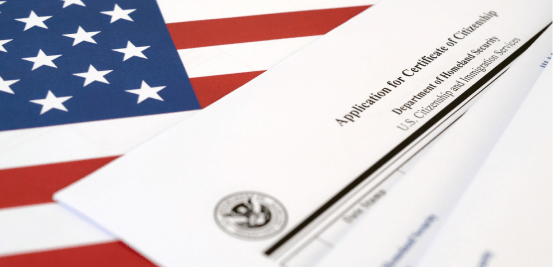
The Joe Biden administration, through the Department of Homeland Security (DHS), published the final "public charge" rule that modifies the previous administration's rule that limited eligibility for permanent residence.
DHS issued the final rule, which it published in the Federal Register on September 9. The 400+ page rule is now clearer on the public charge inadmissibility grounds for non-citizens. The new rule indicates that permanent residence or Green Card applicants will not be penalized for benefiting from public assistance programs, for example, Supplemental Nutrition Assistance Program (SNAP), Medicaid, Children's Health Insurance Program (CHIP), and benefits of housing. Said rule will enter into force on December 23, 2022.
“Public charge” is a term that refers to noncitizens in the United States who are likely to depend on the government for their livelihood. Thus, by being considered a “public charge”, legal immigrants lose their eligibility to obtain legal permanent residence. However, during the previous administration, the rule considered non-citizens who accessed government programs such as those mentioned above to be a public charge. This also led to fewer applications for those programs, due to the public charge rule in place at the time.

With the new rule, the current administration seeks to provide greater clarity and consistency for legal immigrants on the issue of public charge and inadmissibility. This is not an unknown change, since for most of the last two decades, through the Interim Field Guidance of 1999, it contains criteria similar to those of the new rule issued by the DHS.
“This action guarantees fair and humane treatment for legal immigrants and their US citizen family members,” said Secretary of Homeland Security Alejandro N. Mayorkas. In this way, non-citizens will not be penalized for accessing health benefits or other complementary government services that are available to them.
In this sense, the determinations for a non-citizen to become a public charge according to the DHS will be based on: The age of the non-citizen, health and family status, resources and financial status, education and skills. As well as evidence on supplemental income programs, cash assistance, temporary assistance for needy families, and other cash benefit programs at the state, local or territorial level, called General Assistance or general assistance.
"While much remains to be done to overcome confusion and fear, we will continue to work to break down barriers in the immigration system, restore faith and trust with our immigrant communities, and eliminate undue burdens in the application process." explained Ur Mendoza Jaddou, director of the United States Citizenship and Immigration Service (USCIS).
Finally, the DHS announced that it will implement a policy manual for USCIS officials to begin applying this new regulation. Likewise, it will complement with activities for its dissemination and avoid confusion with the immigrant community and with the citizens themselves.